
ATM Testing - April 28, 2026

Advanced Function ATM platforms rely heavily on the CEN/XFS standard to coordinate communication between applications, middleware, and physical devices such as card readers, cash recyclers, PIN pads, and dispensers.
XFS is an enabling technology that provides a client-server API for Windows-based ATM applications to work consistently with hardware components and peripherals from different manufacturers. Unfortunately, managing the number of available device options against the supported versions of the XFS standard has become increasingly complex.
Today a typical ATM estate contains a mix of:
- OEM-specific XFS implementations
- Different firmware and driver versions
- Middleware layers that can interpret XFS services differently
Over time, this creates what many ATM teams experience as XFS fragmentation—subtle behavioral differences between devices and services that technically follow the same standard, but behave differently under real-world operating conditions.
The challenge is that XFS fragmentation rarely produces immediate or obvious failures. Instead, it introduces edge-case behaviors that only emerge when specific combinations of services, timing conditions, firmware versions, or OS updates interact.
These failures are particularly dangerous because they often pass standard lab validation processes and early testing phases, only appearing later during pilots or in live production environments.
The following real-world failure modes illustrate how XFS fragmentation can impact ATM reliability—and why modern ATM testing strategies must account for these hidden interoperability risks.
Real World Failures Caused by XFS Fragmentation
These are the types of failures that escape ATM test labs, only to surface and cause problems at the worst possible time.
Example 1: An OS Patch Exposes XFS Service Timing Issues
What Happens
After a routine OS security patch, intermittent failures appear during card insert, PIN entry, or transaction initialization—despite no application changes.
Why This Occurs
- OS updates alter thread scheduling or timing
- XFS services respond slightly faster or slower
- Application logic assumes deterministic service timing
Operational Impact
- Sporadic card capture or transaction cancellations
- Failures dismissed as “environmental” or “non-reproducible”
- Pilot success masks risk ahead of full rollout
Why VirtualATM Helps
VirtualATM enables repeatable timing and stress scenarios, exposing race conditions that physical labs rarely surface.
Example 2: A Peripheral Firmware Update Breaks Unrelated Services
What Happens
A firmware update to one peripheral (e.g., recycler or card reader) causes unexpected failures in unrelated transaction flows.
Why This Occurs
- Vendor-specific XFS extensions change subtly
- Downstream services rely on undocumented behavior
- Integration testing focuses only on the updated device
Operational Impact
- Features unrelated to the update fail in production
- Root cause analysis becomes slow and inconclusive
- Rollouts are paused or rolled back late in the cycle
Why VirtualATM Helps
VirtualATM supports service level isolation testing, validating how a single XFS change impacts the broader workflow.
Example 3: Mixed OEM Estate Produces Inconsistent Error Handling
What Happens
The same physical error (e.g., note jam, shutter obstruction) produces different XFS error codes across OEMs.
Why This Occurs
- OEM specific interpretations of XFS specifications
- Application logic handles some error variants but not others
- Testing assumes uniform error behavior across hardware
Operational Impact
- Inconsistent customer messaging
- Some ATMs recover gracefully; others go out of service
- “Random” behavior across regions or OEM clusters
Why VirtualATM Helps
VirtualATM allows teams to model OEM specific XFS responses and validate consistent application behavior across the fleet.
Example 4: UAT Passes, Pilot Fails Due to Real-World XFS Diversity
What Happens
User acceptance testing completes successfully, but the pilot deployments fail once exposed to real traffic and configuration diversity.
Why This Occurs
- UAT environments simplify or idealize XFS stacks
- Production introduces additional services and extensions
- Service interactions at scale were never exercised
Operational Impact
- Late stage rollbacks or feature disablement
- Loss of confidence in testing results
- Increased scrutiny from operations and InfoSec teams
Why VirtualATM Helps
VirtualATM enables production like XFS service matrices to be tested earlier, reducing the gap between UAT success and pilot reality.
Example 5: The Recycler Accepts Cash, But The Deposit Workflow Fails Mid-Transaction
What Happens
A cash recycler successfully accepts notes, but the deposit transaction fails when the application requests escrow confirmation or recycling status.
Why This Occurs
- Recycler XFS service uses a newer event model
- Application or middleware expects legacy event sequencing
- Lab testing used a different firmware or XFS service version
Operational Impact
- Customer experiences a failure after cash insertion
- Funds may be delayed, reversed, or require manual reconciliation
- Issue is difficult to reproduce outside the field
Why VirtualATM Helps
VirtualATM simulates multiple recycler XFS behaviors and event sequences, allowing these incompatibilities to be identified before deployment.
These examples illustrate a broader operational reality for ATM deployers: XFS fragmentation is not an exception—it is the norm.
Managing the Unmanageable
Modern ATM estates combine multiple hardware vendors, device firmware versions, middleware layers, and OS builds. Even when each component individually complies with the XFS specification, subtle behavioral differences can emerge when those components interact in real transaction workflows.
Because these issues often depend on timing, sequencing, or service-level interactions, they are notoriously difficult to reproduce using traditional ATM lab environments. Physical test labs typically represent only a small subset of the possible XFS combinations present across a production ATM fleet.
This is where Paragon’s VirtualATM platform plays a critical role.
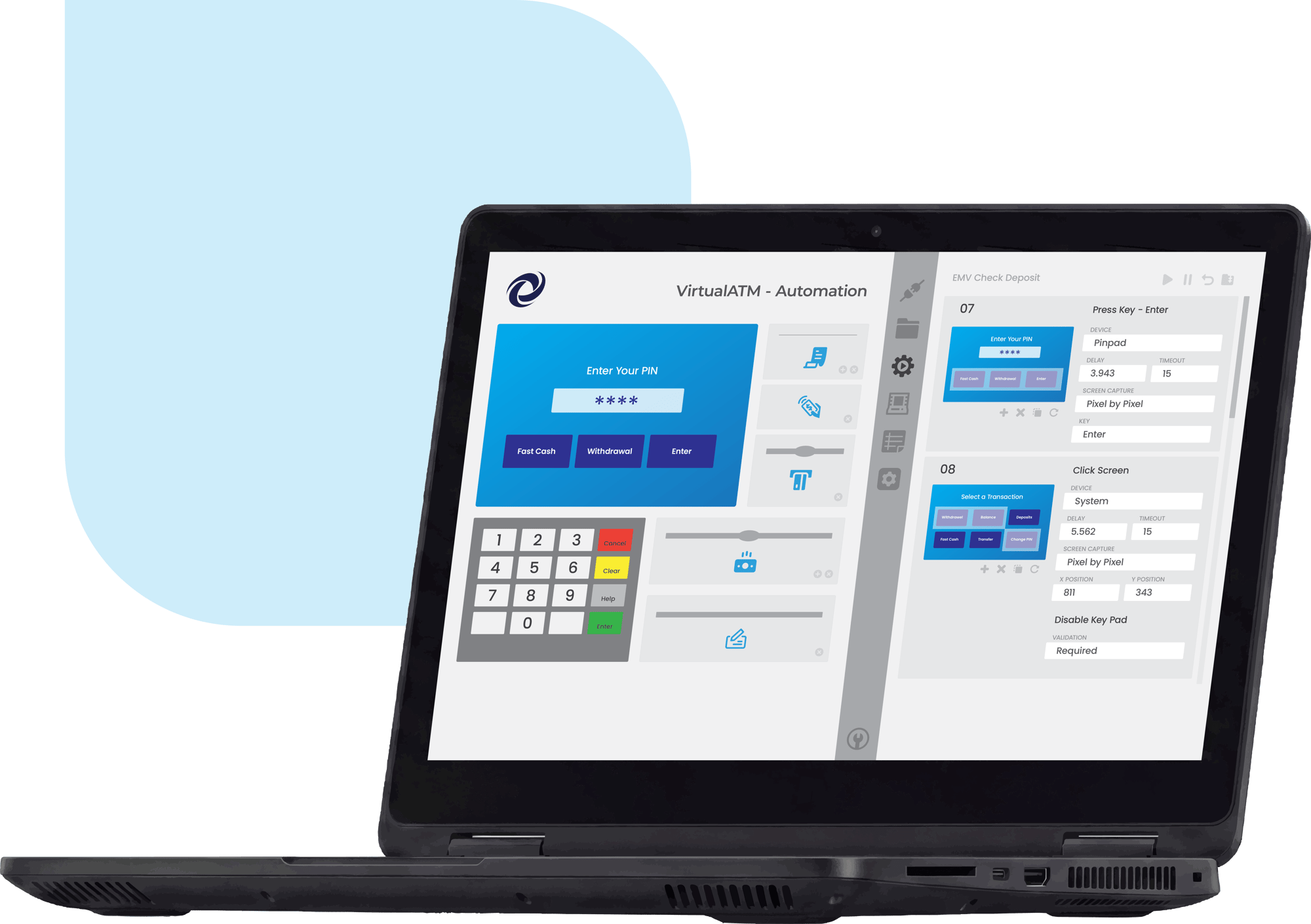
VirtualATM provides a virtualized environment that simulates ATM devices and XFS services, enabling teams to test how applications behave across a wide range of device responses, timing conditions, and service interactions—without relying on physical ATM hardware.
By allowing teams to model different XFS behaviors, device implementations, and workflow scenarios, VirtualATM helps organizations:
- Identify interoperability issues earlier in the development cycle
- Validate application behavior across diverse ATM device environments
- Reproduce edge-case service interactions that physical labs rarely expose
- Increase confidence that tested workflows will behave consistently in production
As ATM ecosystems continue to grow more complex, testing must evolve from validating individual transactions to validating the behavior of entire XFS service environments.
With VirtualATM, ATM teams can move closer to that goal—detecting the hidden effects of XFS fragmentation before they become visible to customers.

A Guide to ATM Testing
In this guide, we explore a number of issues and challenges associated with the continued reliance on manual ATM testing and provide information and advice on how to use virtualization technology to automate and streamline the ATM testing process.