
ATM Testing - April 28, 2026

In our previous article, we explored how ATM teams can begin their journey into automated testing with a small, low-risk step: creating a virtual ATM sandbox and automating a limited set of core transaction scenarios.
For many organizations, that first step reveals something encouraging.
Automation isn’t as difficult as it once seemed. But a natural question soon follows.
What happens next?
Once you have proven the value of automation, the next step is to scale the approach and bring your team along the journey.
The good news is that this stage is not about replacing people. It is about expanding, enhancing, and elevating their capabilities.
Automation Doesn't Replace Your Test Team
A common concern when companies begin exploring automation is that it might somehow make existing testers redundant.
In practice, the opposite tends to happen.
Experienced ATM testers bring something incredibly valuable to the automation journey:
- A deep understanding of financial messages and transaction processing
- Practical knowledge of real-world ATM behavior
- Awareness of the subtle edge cases that only appear in production
Automation simply gives them better tools to apply that expertise.
Instead of spending hours repeating the same transactions manually, test specialists begin to focus on designing richer test scenarios and improving coverage across the ATM network.
Their role evolves from manual execution to test engineering.
Building New Skills Inside the Test Lab
As automation expands, ATM teams typically begin developing a few new skill areas.
The first is automated test scenario design.
Testers who once executed scripts manually begin learning to define and manage automated scenarios that can be replayed. Over time, teams will learn to build extensive test libraries covering hundreds or even thousands of transaction cases.
The second skill area is virtual ATM fleet management.
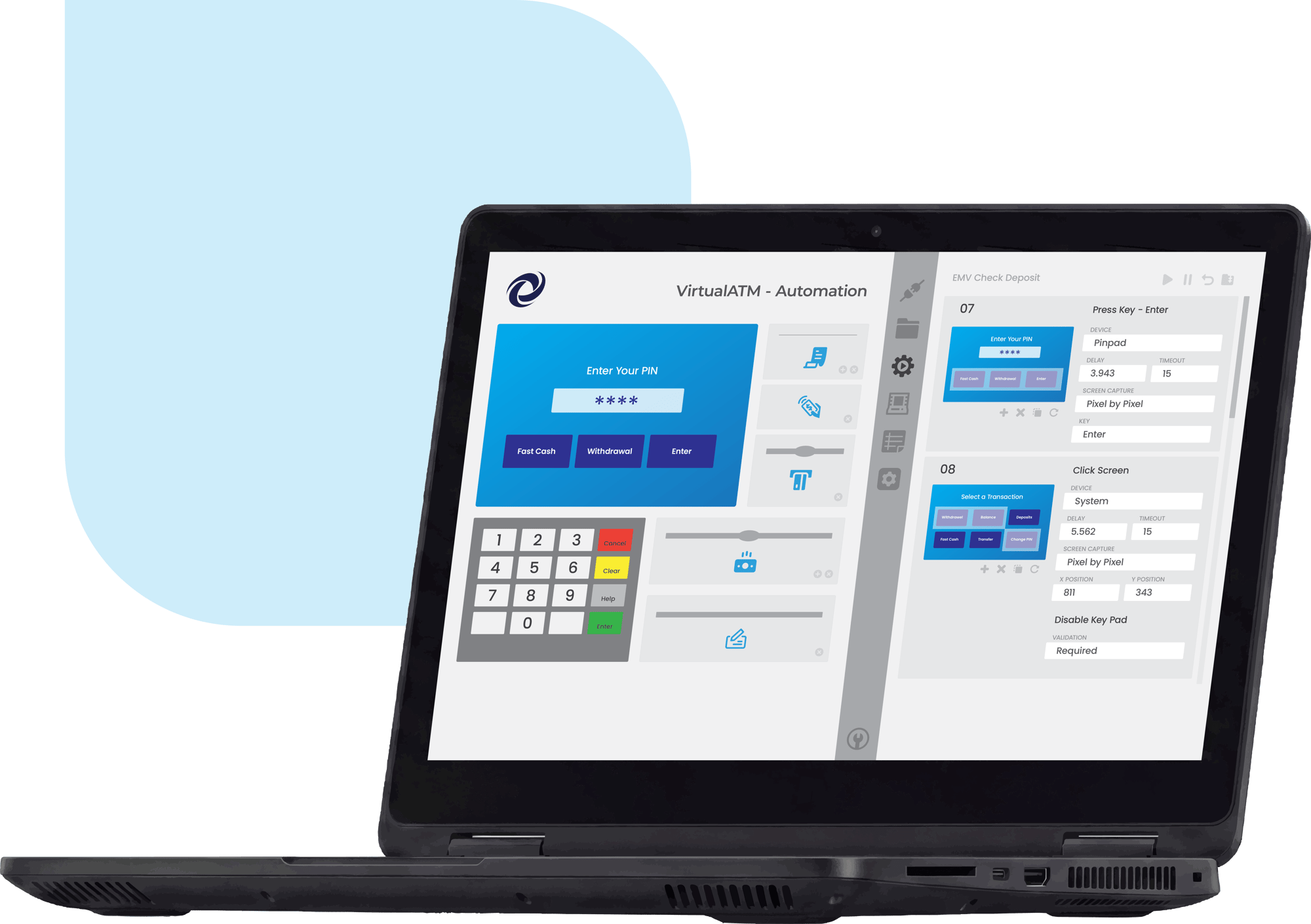
Using ATM virtualization tools, it becomes possible to take an image of a physical ATM configuration and render it as a virtual device. Once this process is understood, additional virtual ATMs can be created by cloning and adjusting configuration parameters.
This allows teams to gradually build a virtual ATM fleet that mirrors their real-world environment.
With this capability, test teams can introduce new scenarios, simulate different ATM models, and test software changes across multiple device types without needing additional hardware.
For many organizations, this becomes a powerful turning point.
Testing capacity can then scale far beyond what was possible with physical devices alone.
Growing Automation at a Comfortable Pace
One of the most important aspects of successful automation programs is that they grow at a pace that suits the operation.
The initial implementation phase of the project may have focused on automating a limited set of transactions.
The next logical step is therefore to expand that coverage.
For example:
- Adding additional ATM models to the virtual test environment
- Increasing the number of automated transaction scenarios
- Building more advanced test cases, including negative testing and error handling
- Running larger automated regression suites during development cycles
As this capability grows, development teams often start to experience faster feedback on their software changes.
Testing cycles begin to shorten. Confidence in release timing and quality begins to improve. At this stage, ATM test managers often have a choice in how quickly they wish to expand the capability.
Some companies prefer to grow organically, allowing their teams to develop new automation skills through their daily work gradually.
Others may choose to accelerate the journey by temporarily bringing in additional expertise.
In these situations, a staff augmentation model can be particularly effective.
Experienced ATM testing specialists can work alongside the internal team for a defined period, helping to:
- Accelerate the expansion of automated test coverage
- Introduce best practices in test automation and virtualization
- Mentor internal staff and transfer knowledge
- Support the introduction of new ATM models into the virtual environment
This approach allows businesses to increase momentum while still ensuring that long-term ownership of the automation environment remains with the internal team.
Over time, external specialists step back as internal capability grows.
Extending Beyond the Sandbox
At this stage, many fleet operators choose to extend their initial pilot environment.
This allows them to expand testing coverage and explore additional use cases while continuing to build internal skills.
For example, the test lab manager might decide to:
- Add additional ATM models to the virtual environment
- Automate more complex test scenarios
- Train additional team members on the automation tools
This gradual expansion allows operations to build confidence and capability before committing to a larger rollout.
Over time, however, many teams reach a natural point where they realize something important.
The automated environment has become an essential part of their testing strategy.
At that stage, the organization often moves from a limited deployment scenario to a true production implementation, enabling its resources to take full ownership of the environment and scale it across the enterprise.
A New Role for the ATM Test Lab
When this evolution happens, the ATM test lab itself begins to change.
Instead of acting primarily as a manual execution team, the lab becomes something far more strategic.
It becomes the place where:
- Automated regression testing is maintained and expanded
- New ATM features are validated quickly
- Edge cases and fraud scenarios are explored
- Developers receive faster feedback on their software changes
In short, the test lab becomes a driver of innovation rather than a bottleneck.
The Future Looks Bright
Once automation reaches this stage, organizations often begin exploring how to integrate automated ATM testing more deeply into their development processes.
For example:
- running automated test suites as part of release pipelines
- detecting defects earlier in the development cycle
- improving software quality before it ever reaches production
In our next article, we will explore how ATM networks can take this final step by integrating automated ATM testing into modern continuous integration and continuous delivery (CI/CD) environments.

A Guide to ATM Testing
In this guide, we explore a number of issues and challenges associated with the continued reliance on manual ATM testing and provide information and advice on how to use virtualization technology to automate and streamline the ATM testing process.