
ATM Testing - April 28, 2026
.png?width=1110&name=Hubspot%20image%20(14).png)
Picture an Advanced Function ATM mid-transaction. The card reader initializes, EMV kernels negotiate, cash handling devices respond in real time, and fraud or personalization logic is evaluated, all coordinated through CEN/XFS services.
In this environment, Windows is not just an operating system. It is a foundational dependency that influences timing, service behavior, device drivers, and middleware interaction.
Every Windows patch, security update, or OS upgrade can subtly alter how these components behave. And for Advanced Function ATMs, those changes are rarely isolated.
OS Modernization is No Longer a One-Time Project
Historically, ATM OS upgrades were treated as discrete initiatives:
- Plan the upgrade
- Validate core transactions
- Deploy
- Move on
That traditional model no longer holds true.
In 2026, Advanced Function ATM deployers face continuous OS change driven by:
- Security patch cadence dictated by InfoSec teams
- Windows 10 LTSC lifecycle pressure and future Windows 11 considerations
- Evolving security baselines and hardening requirements
- Middleware and device drivers that lag OS updates
What was once a traditionally managed upgrade project has become permanent operational drag.
Why OS Changes Are So Risky for Advanced Function ATMs
Advanced Function ATMs differ fundamentally from traditional states-and-screens machines. They are stateless at the application level and depend on the real-time behavior of XFS services.
This creates several modernization risks:
Timing and Behavior Shifts - OS updates can change thread scheduling, memory handling, or service startup timing. Even small shifts can expose race conditions that never appeared before.
Driver and Middleware Sensitivity - device drivers and middleware are often tightly coupled to specific OS builds. A security patch can introduce behavior changes without any application code being modified.
Certification Fragility - previously certified EMV contact, contactless, and advanced workflows may no longer behave identically after an OS change—forcing revalidation.
The result: deployers must repeatedly retest the same workflows, often under tight timelines and with limited ATM hardware availability.
Why the Traditional Approach to ATM Testing Breaks Down
Most ATM test environments were never designed for continuous OS validation. They assume:
- Stable operating systems
- Predictable service behavior
- Limited regression frequency
In reality:
- Physical ATM labs can’t easily scale to validate every patch level
- Manual regression testing takes too long and becomes a bottleneck
- Late discovery of issues pushes risk into UAT or pilot
This is why many OS-related failures are not caught until after deployment, when correcting them is both visible to consumers (i.e., embarrassment for your brand) and very expensive.
How VirtualATM Changes the OS Modernization Equation
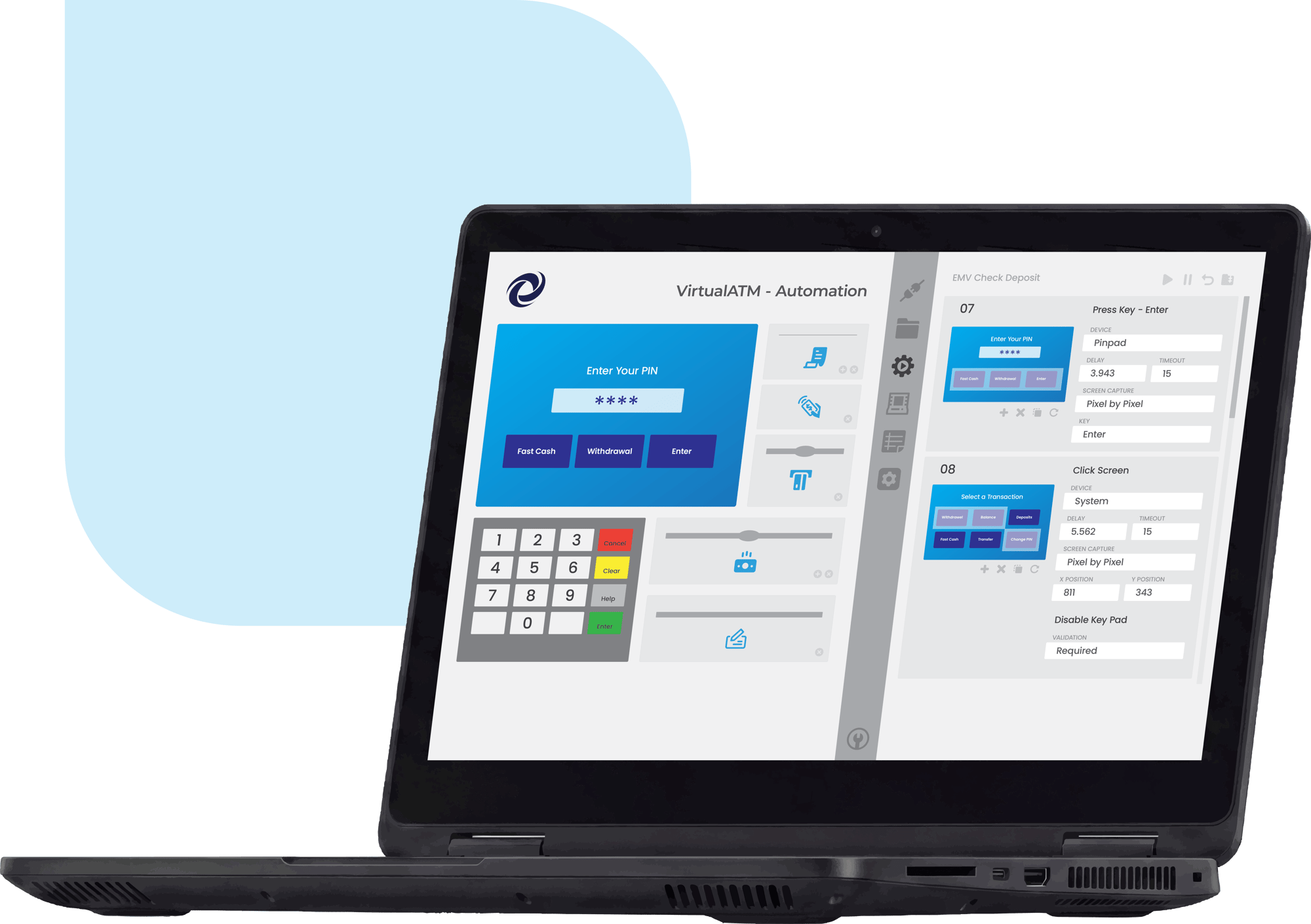
Paragon’s VirtualATM platform is designed specifically to support continuous validation in Advanced Function ATM environments.
Virtualized XFS Services - VirtualATM simulates real ATM devices and XFS services, allowing teams to test OS changes without relying on physical hardware.
This enables validation of:
- Driver and middleware behavior across OS versions
- Timing and sequencing changes introduced by patches
- Advanced function workflows under realistic conditions
Automated Regression at Scale
Once transaction and workflow tests are automated, they can be rerun:
- After every OS patch
- Across multiple OS builds
- Without consuming lab hardware or field machines
This dramatically reduces manual effort while increasing coverage.
Certification Reuse with Confidence - by validating unchanged behavior via automated regression testing, teams can reuse prior certifications intelligently, focusing effort only where behavior actually changes.
24×7×365 Testing Without Operational Impact - VirtualATM environments are always available. Testing no longer competes with development, UAT, or production schedules.
Move From Periodic Upgrades to Continuous Validation
The most successful ATM deployers have already made this shift:
- OS modernization is treated as ongoing change, not a milestone
- Testing is continuous, automated, and repeatable
- Validation focuses on service behavior and workflows, not just transaction success
VirtualATM enables this operating model by aligning testing with the reality of modern ATM platforms.
Continuous Change Requires Continuous Testing
Windows modernization for Advanced Function ATMs is no longer a project that you simply "finish". It is an ongoing operational reality that must be managed continuously.
With every OS update, ATM deployers face the risk of subtle changes in XFS services, device drivers, middleware interactions, and transaction timing. Without a reliable, repeatable, and scalable way to validate these changes, even routine security patches can introduce unexpected behavior into production ATM fleets.
Paragon’s VirtualATM platform is designed specifically to address this challenge.
VirtualATM provides a fully virtualized ATM environment that simulates real XFS devices and services, allowing teams to test Advanced Function ATM workflows without relying on physical hardware.
This allows organizations to:
- Validate OS patches and upgrades against real transaction workflows
- Detect changes in XFS service behavior before deployment
- Run automated regression testing across multiple OS builds
- Reduce dependency on expensive ATM lab hardware
- Test continuously without interrupting development or UAT environments
By virtualizing ATM devices and enabling automated test execution, VirtualATM allows ATM teams to move from frantically reacting to the latest urgent security alert or compliance mandate to an environment where continuous testing and validation are aligned with modern OS update cycles.
With VirtualATM, organizations can:
- Reduce OS-related production incidents
- Validate Windows updates faster and with greater confidence
- Maintain certification stability across OS changes
- Scale testing coverage without increasing manpower
In an ATM environment where Windows updates are constant and service behavior is tightly coupled to the OS, confidence comes from being able to test continuously, accurately, and reliably at scale.
That’s exactly what VirtualATM makes possible.


FAQs
Why is Windows modernization especially challenging for Advanced Function ATMs?
Because Advanced Function ATMs depend on real-time XFS service behavior. OS changes can alter timing, driver interaction, or middleware behavior even when application code is unchanged.
Do OS updates really require full retesting?
Every OS change carries risk. Automated regression testing allows teams to revalidate efficiently and focus effort only where behavior changes.
How does VirtualATM reduce modernization risk?
VirtualATM simulates real ATM devices and services, enabling repeatable, automated testing across OS versions without relying on physical hardware.
Is this about states and screens or load files?
No. Advanced Function ATMs are stateless at the application level. OS modernization is a runtime service and regression testing problem, not a configuration management problem.
A Guide to ATM Testing
In this guide, we explore a number of issues and challenges associated with the continued reliance on manual ATM testing and provide information and advice on how to use virtualization technology to automate and streamline the ATM testing process.