
Payments - August 25, 2026
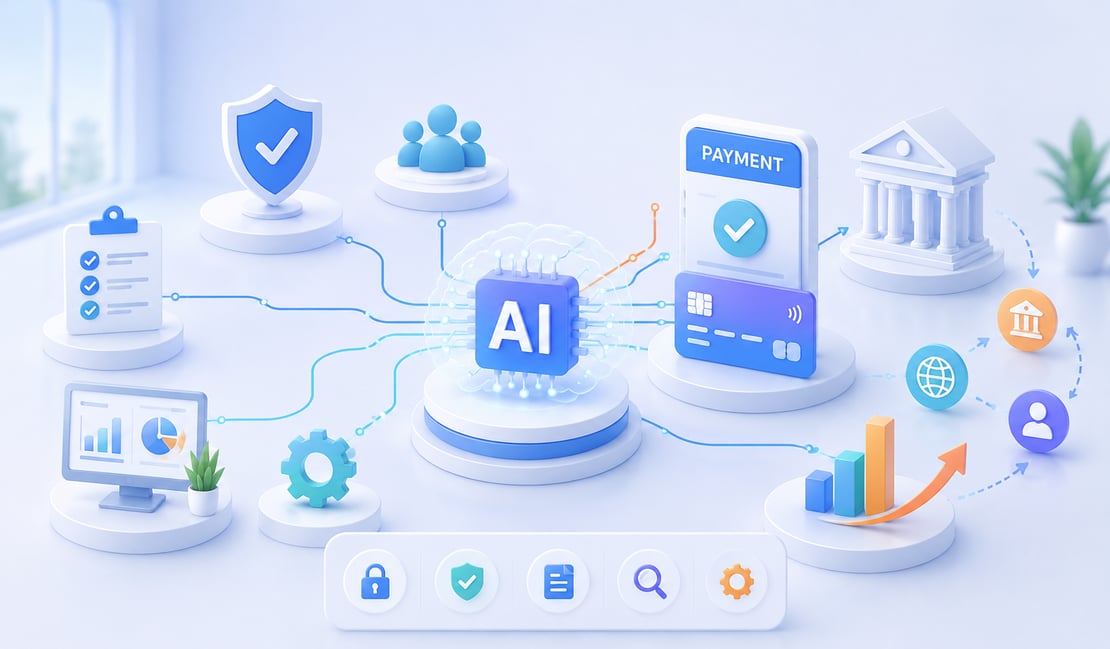
As the CEO of Paragon, I spend a lot of time thinking about the future of the payments industry and the role testing will play in shaping it.
Lately, many of the questions that I have been asking are centered around AI: how it’s being used, where it’s creating real value, and where it introduces new challenges.
This blog is part of our ongoing exploration on this important subject that starts with a simple question:
What happens when a payment is no longer initiated by a person, but by a machine?
Not suggested. Not assisted. Actually executed by AI.
That’s not a future scenario; it has already started to happen.
And if you work anywhere in the payments domain, that shift should get your attention.
From Helpful to Autonomous
For years, AI has been quietly improving the global payments ecosystem:
- Better fraud detection
- Smarter risk scoring
- Faster data analysis
- More efficient operations
All valuable. All incremental.
But we’re now crossing into something fundamentally different. AI is starting to move from helping people make decisions to making and acting on decisions itself.
And that’s a big deal.
Because once an AI system is:
- Choosing vendors
- Approving actions
- Initiating transactions
You’re no longer just validating a transaction, you’re validating intent. And that’s a much harder problem.
Payments Become the Trust Layer
In payments, trust has always been earned through process—not perception.
It comes from things like:
- Authentication
- Authorization
- Auditability
- Repeatability
Those guardrails are what allow our diverse payment systems to work at scale.
But AI introduces pressure on all of them:
- Who actually authorized the transaction?
- How do you confirm the system acted within its intended boundaries?
- Can you explain why a decision was made?
- And if something goes wrong… who is accountable?
These aren’t academic questions. They’re practical ones that will determine how fast AI actually gets adopted in production environments.
Because here’s the reality:
AI won’t be limited by its capabilities in payments; it will be limited by trust.
Why This Matters Right Now
There’s a lot of excitement around AI right now and much of it is justified.
But in payments, the wrong approach is to ask:
“What can we do with AI?”
The better question is:
“Where can we trust AI to operate—and where do we need to stay in control?”
Move too fast without answering that, and you introduce additional risk into systems where risk isn’t tolerated. Move too slow, and you miss the opportunity to improve organizational speed, efficiency, and decision-making.
The companies that get this right won’t be the ones moving the fastest. The winners will be the organizations that:
- Move deliberately
- Build guardrails early
- And keep control as the system evolves
What We’re Seeing at Paragon
At Paragon, we sit in a part of the ecosystem where precision matters—testing, certification, and validation. So as we’ve worked through how AI fits into our business, one thing has become clear:
AI makes strong systems stronger—but it also exposes weak ones very quickly.
We’ve taken what we think is a very practical approach.
We’re starting in areas where AI can add value to our business without introducing new risk, such as:
- Analyzing test results and surfacing issues faster
- Supporting our teams with better insights and productivity tools
- Improving how we interpret large volumes of system data
At the same time, we’ve been very intentional about boundaries. There are parts of the payment process where determinism is non-negotiable and those don’t get replaced.
We also don’t just treat AI output as “done.” It gets validated, reviewed, and tested—just like anything else that touches our systems.
Because at the end of the day:
If you can’t trust the output, it doesn’t matter how fast you got it.
Where This Is Going
AI is going to continue pushing forward in payments—but not all at once.
We expect things to move in stages:
- Assistance
- Guided automation
- Delegated decisions
- Controlled autonomy
Each step creates opportunity. Each step also raises the bar on trust. And that’s where I think the conversation needs to shift.
We need less focus on:
- Hype
- Tools
- Features
And more focus on:
- Control
- Auditability
- Reliability
- Accountability
Because those are the things that will ultimately determine what gets used in production.
Let’s Keep This Conversation Going
Over the next few weeks, you’ll hear more from the Paragon team on this topic—from operations, product development, and go-to-market perspectives.
We’re not trying to chase headlines or add to the noise. We’re trying to answer a simple question:
What does responsible, real-world AI adoption look like in payments?
If this is something you’re thinking about in your own organization, I’d be interested in your perspective.
- Where are you seeing AI add real value?
- Where are you still skeptical?
- What would need to change for you to trust it in production?
Feel free to reach out or share your thoughts.
Because this next phase of payments won’t just be defined by technology—
It will be defined by who learns how to trust it.

FAQs
What does autonomous AI in payments actually mean?
It means AI systems are starting to move beyond recommendations and toward initiating decisions and transactions themselves.
Why is trust such a major issue for AI in payments?
Because payments rely on clear authorization, accountability, and auditability—areas where autonomous AI introduces new complexity.
Will AI replace human decision-making in payments?
Not entirely. In high-risk environments, human oversight and validation will remain critical.
Where is AI adding the most value in payments today?
Mostly in fraud detection, operational efficiency, data analysis, and workflow automation.
What will determine successful AI adoption in payments?
The ability to build trustworthy systems with strong controls, transparency, and clear operational boundaries.

Free Guide to Payment Testing
Read our free guide to explore a number of key concepts, issues and challenges specifically related to payment testing.