
Payments - August 25, 2026
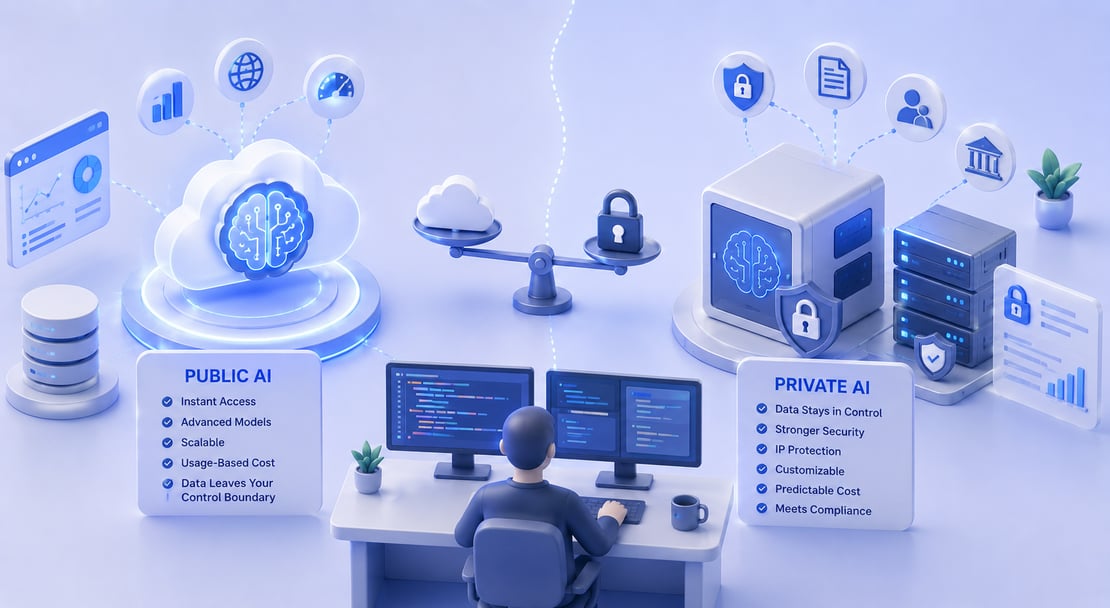
Artificial intelligence is quickly becoming embedded in how software is built, tested, and operated. Most of the discussion has centered on model capability, e.g., who has the best models, the fastest responses, or the most advanced reasoning. But that is not the question enterprises are actually asking.
The real question is: Where is the AI running - and who controls it?
For organizations operating in regulated environments like payments, the distinction between public AI and private AI is about more than just cost. The bigger enterprise question is whether the organization can protect intellectual property, control where sensitive data is processed, meet customer and regulatory expectations, and still deliver enough performance for real productivity gains.
Public AI: Strong Models, Fast Access, and External Trust Boundaries
Public AI services, such as those provided by Anthropic, OpenAI, Google, and others, offer immediate access to some of the strongest hosted models available. They are especially attractive when teams need advanced reasoning, broad general knowledge, multimodal capabilities, or rapid experimentation without standing up internal infrastructure.
The advantages are:
- No infrastructure to manage
- Immediate access to advanced models
- Continuous improvements without internal effort
This is why most organizations start here. It is fast, flexible, and has low friction. However, that simplicity comes with a tradeoff that becomes more apparent over time: public AI is priced based on consumption.
Every request, every prompt, every iteration has a cost attached to it. As usage grows, cost grows with it. More importantly, sensitive context may cross an external trust boundary. Even when vendors provide enterprise controls, the organization is still relying on outside infrastructure, external retention policies, third-party audit posture, and contractual protections to safeguard data.
Private AI: Security First, with Cost and Performance Managed Deliberately
Private AI operates differently. Instead of sending data to an external service, models run inside an environment the organization controls. This could be on premises, in a private cloud, inside a customer-controlled deployment, or directly on a developer workstation. This approach requires more upfront planning and investment:
- Hardware
- Model management
- Operational oversight
The security benefit is immediate: prompts, source code, specifications, customer data, test artifacts, and internal documents can stay inside the organization’s control boundary. That does not eliminate all risk, but it significantly reduces the risk surface compared with sending sensitive context to a third-party hosted service.
Security: The Primary Reason Private AI Matters
The most important argument for private AI is security. In software development, the highest-value AI prompts often contain exactly the information organizations most need to protect: proprietary source code, architecture diagrams, product roadmaps, customer configurations, defect histories, payment specifications, logs, and internal troubleshooting details.
Private AI gives organizations stronger control over:
- Data residency — sensitive information remains in an approved environment.
- IP protection — source code and proprietary designs do not need to be transmitted to an external provider.
- Auditability — prompts, responses, model access, and system behavior can be logged under internal policy.
- Access control — usage can be tied to internal identity, role-based permissions, and customer-specific boundaries.
- Customer confidence — regulated customers can see that AI features run in a controlled environment rather than an opaque external service.
This is why private AI is more than a deployment preference. For enterprise products, especially in payments and financial systems, it becomes part of the trust model. If AI is allowed to inspect transaction flows, certification scripts, protocol mappings, logs, or customer-specific configurations, customers will reasonably ask where that processing happens and who can access it.
Performance: Strong Public Models vs Strong Private Models
The strongest public AI models still tend to lead in broad reasoning, multimodal capability, long-context generalization, and polished tool ecosystems. For complex analysis, ambiguous reasoning, and tasks that benefit from the very latest frontier model, public AI often has an advantage.
However, the gap between public and private models has narrowed significantly. Strong open-weight and privately deployable models are now capable enough for many enterprise workflows, especially when paired with retrieval-augmented generation, code indexes, internal documentation, and domain-specific prompting. In those scenarios, a private model that understands the organization’s own context can actually outperform a stronger public model that cannot safely receive the relevant data.
The tradeoff is infrastructure. Stronger private models require more GPU memory, higher-end servers, more operational monitoring, and thoughtful capacity planning. A large private model may require dedicated GPU servers or a shared inference cluster. That increases upfront cost, but it also creates a controlled, reusable asset that can support many internal workflows without sending protected data outside the organization.
Performance: Lightweight Public Models vs Lightweight Private Models
Not every AI workload needs a frontier model. Many day-to-day developer tasks, such as summarizing code, explaining errors, generating test cases, drafting documentation, translating examples, or assisting with smaller refactors, can be handled well by smaller models.
Lightweight public AI models provide low-latency access and lower per-token pricing than premium hosted models. They are useful for non-sensitive workloads and general productivity. But they still share the same architectural concern: data leaves the organization unless the provider and deployment model are explicitly designed to prevent that risk.
Lightweight private models create a different opportunity. They may not match the strongest public models, but they can be good enough for many internal engineering tasks while keeping sensitive data local. Because these models require less GPU memory and compute, they can reduce infrastructure costs dramatically compared with running a high-end private model for every request.
This suggests a tiered model strategy: reserve high-end public or private models for the hardest tasks, and use smaller private models for the high-volume work where security, speed, and cost predictability matter most.
Developer-Local AI: Keeping IP on the Desktop
Another private AI approach is becoming increasingly practical: running a local LLM directly on each developer’s workstation. A developer with a reasonable 16GB GPU can run a capable local model for many coding and documentation tasks without source code, specifications, or customer context, leaving the desktop.
This approach has several advantages:
- Source code and IP remain on the developer's machine.
- Developers can use AI freely without generating a per-request API cost.
- Latency is minimal for smaller prompts because inference happens locally.
- The organization can standardize approved models, tools, and configuration profiles.
- Central infrastructure demand is reduced because routine development assistance is pushed to local workstations.
Of course, developer-local AI will not replace all centralized AI services. Larger models, shared knowledge bases, product-level AI features, and customer-controlled deployments still require managed infrastructure. But for day-to-day development work, local models provide a practical security-first option: useful AI assistance without moving confidential code outside the developer’s system.
Cost: Important, but Secondary to Security and Control
Cost still matters, but it should not be treated as the only argument for private AI. The real question is whether the cost model aligns with secure, scalable usage. Public AI pricing is fundamentally consumption-based:
- More usage → more cost
- More users → more spend
- More integration → higher exposure
Private AI flips that model:
- Higher initial cost
- Nearly zero marginal cost per request
Once the infrastructure is in place, additional usage does not drive cost in the same way. Instead, higher usage reduces the effective cost per interaction.
In Paragon's own experience working with internal AI infrastructure, this has led to a different outcome than expected:
- Increased adoption did not increase cost proportionally
- Teams were able to use AI more freely without budget constraints
- Overall cost became predictable and controlled, rather than variable
For enterprise environments, that shift matters because it changes both behavior and governance. Teams can use AI more freely, while the organization retains control over what data is processed, where it runs, and how usage is audited.
Why Predictability Matters More Than Lowest Cost
Enterprises are not optimizing for the lowest possible cost. They are optimizing for control and predictability.
Consumption-based AI introduces variability:
- Monthly costs fluctuate
- Usage limits need to be managed
- High-value workloads become expensive to scale
Private AI removes that variability:
- Fixed infrastructure cost
- Known capacity
- No per-request pricing pressure
This changes how teams behave.
Instead of asking, “Can we afford to use AI for this?” they can ask, “Where does AI add the most value?” That is a fundamentally better place to operate from.
Security, Cost, and Performance Are Connected
Most discussions treat security, cost, and performance as separate decisions. In practice, they are tightly connected. Private AI gives organizations:
- Data control – sensitive inputs never leave their environment
- Operational control – AI behavior can be constrained and audited
- Performance control – workloads can be routed to the right model tier, from local lightweight models to centralized high-end private models
This is especially relevant in payments and financial systems. When AI interacts with transaction data, specifications, test configurations, customer environments, or proprietary source code, it is no longer just a productivity tool - it becomes part of the enterprise trust model. That requires a different level of control.
Where Public AI Still Fits
This is not an argument against public AI. Public models remain extremely valuable, particularly for:
- Early-stage experimentation
- Generalized reasoning tasks
- Non-sensitive workflows
The right approach is not “private vs public.” It is using the right model in the right place, with the right level of control. In many cases, that leads to a hybrid model.
A Practical Hybrid Model
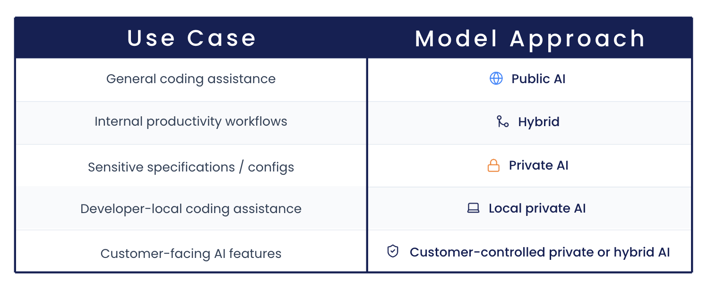
This gives organizations flexibility without sacrificing control.
What This Means for Product Design
As AI capabilities become embedded in enterprise platforms, this distinction becomes a product requirement, not just an architectural decision. For customer-facing systems, this means:
- AI features must support private deployment options
- Customers must have control over where models execute
- Systems must support auditability and policy enforcement
This is especially true for:
- AI chat/help systems
- Test automation generation
- System analyzers and diagnostics
Customers are no longer asking if AI exists in a product. They are asking whether they can run it in a way that meets their requirements.
Closing Thought
The companies that succeed with AI in enterprise environments will not be the ones with access to the most powerful models. They will be the ones who provide:
- The most control over how those models are used
- The most predictable operational behavior
- The most stable cost structure as usage grows
In that context, private AI is not just a cost decision. It is a security and architecture decision about how AI scales—technically, operationally, and economically—without forcing sensitive data outside the organization’s control.

FAQs
1. What is the difference between private AI and public AI?
Public AI refers to hosted models from providers such as OpenAI, Anthropic, or Google, accessed via external APIs on a per-use basis. Private AI runs inside an environment the organization controls—on-premises, in a private cloud, or directly on a developer workstation—so sensitive data, source code, and customer context never leave the organization's trust boundary.
2. Why is private AI important for companies in regulated spaces like payments?
In regulated environments, AI often interacts with proprietary source code, transaction data, customer configurations, and compliance-sensitive information. Private AI keeps that data inside an approved environment, supports auditability and role-based access, and gives customers confidence that AI features run under controlled, policy-enforced conditions rather than an opaque external service.
3. Is private AI more cost-effective than public AI?
It depends on usage. Public AI has a low upfront cost, but scales linearly with consumption, i.e., more users and more requests mean higher spend. Private AI requires a larger upfront investment in hardware and operations, but the marginal cost per request is near zero. For organizations with growing AI adoption, private AI typically delivers more predictable, controlled costs over time.
Free Guide to Payment Testing
Read our free guide to explore a number of key concepts, issues and challenges specifically related to payment testing.