
Payments - August 25, 2026
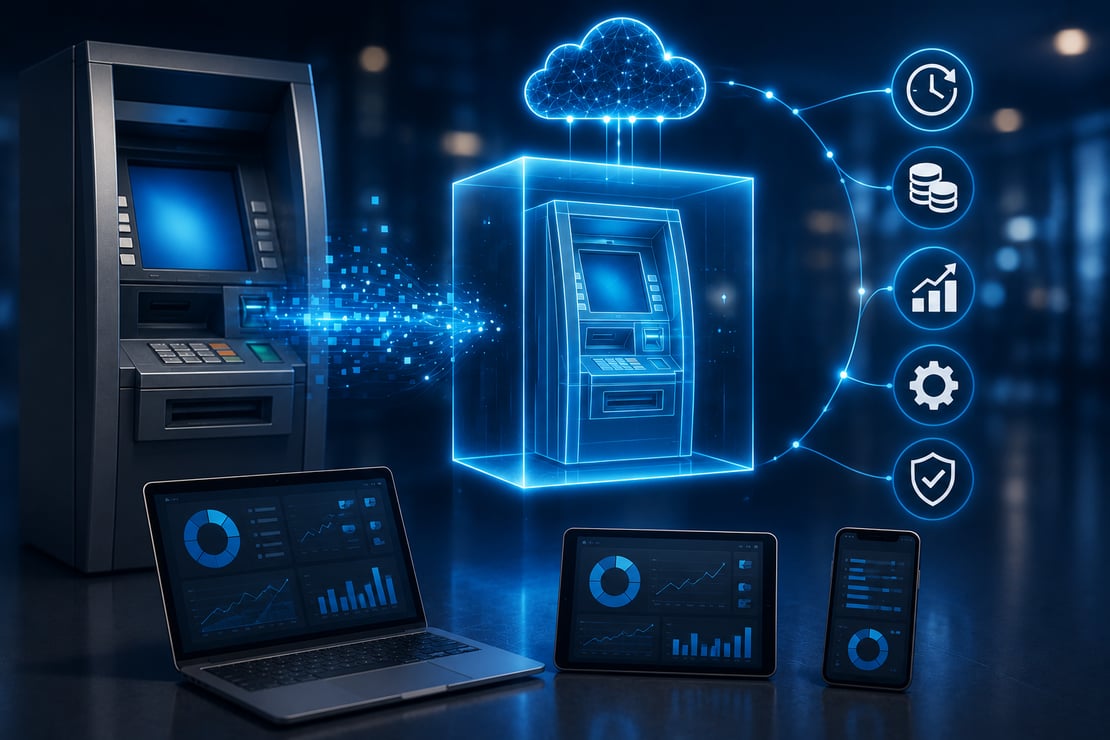
After nearly 60 years, the ATM is still doing essential work for the banking industry. It continues to provide consumers with convenient access to their cash, as well as a growing menu of value-added financial services. The self-service channel is not fading; it is simply evolving.
Keeping this valuable touchpoint healthy is another matter entirely. Overseeing and validating an ATM fleet is serious business, and the old playbook no longer fits. To stay competitive, maintain efficiency, enhance security, and still deliver a flawless customer experience, ATM deployers must move away from their reliance on manual testing process and adopt modern tools and technology — including virtualization and automation, enabling round-the-clock, location-independent access to the test environment.
This piece unpacks what ATM virtualization actually is, why it has become the smart foundation for a modern test operation, and how to integrate it into your own testing workflow — step by step. Think of it as a field guide to getting a physical ATM off the lab floor and into software with Paragon VirtualATM®.
Simulation vs. Virtualization: Why the Difference Matters
It's easy to lump virtualization in with simulation, but they solve the problem at very different depths. A simulator merely imitates how an ATM behaves — a useful approximation, but an approximation nonetheless. Virtualization goes considerably further: it takes an authentic copy of the complete ATM software stack — the operating system, the application itself, configuration, and log files — and lifts it cleanly off the physical hardware.
In practice, a virtual ATM is the equivalent of your entire ATM software stack captured and converted into a fully deployable, scalable software replica. Paragon layers in simulated hardware for the ATM's peripheral devices, so every transaction is reproduced in software with enough fidelity to faithfully mirror how the physical machine would respond. Because you're testing what the host genuinely sees — right down to EMV, card data, and cryptography at the message and protocol level — the results are trustworthy rather than merely indicative.
That depth is what unlocks the payoff. A virtualized ATM delivers a significant number of advantages that a physical-only lab simply can't match:
- Round-the-clock remote testing through cloud-hosted software, so your teams reach the environment 24×7×365 from anywhere on the map.
- Dramatically lower hardware and facilities spend, since you rely less on costly lab machines and dedicated real estate.
-
Greater speed, throughput, and coverage, because capacity scales by simply cloning another virtual ATM on demand.
-
Native support for automation and programmatic control of ATMs through a published RESTful API that can plug into CI/CD pipelines.
-
Safe fault and negative testing — you can generate device faults with no risk of damaging real, fragile, expensive hardware.
A Step-by-Step Path to a Virtualized ATM
So how does an ATM fleet owner actually put virtualization to work? Paragon's VirtualATM supplies both the underlying technology and a clear, repeatable method for capturing, converting, and deploying an ATM image into a virtual environment.
Here is a high-level overview of the process - and it's simpler than most teams expect.
Step 1. Get the target ATM in full working order
Before anything else, confirm the machine you're about to virtualize is operating correctly and running the latest software. Every transaction should complete successfully, with no defects, because any issues or faults present at capture time get carried over into the virtual image.
Step 2. Capture the ATM hardware profile
Reliable testing depends on knowing exactly which devices are configured on the target ATM, e.g., the encrypting PIN pad, card readers, printers, cash cassettes, and the rest. Paragon's profiler scans every XFS component, its firmware, configuration, and capabilities, and assembles a precise digital twin of the machine's hardware.
Step 3. Image the system
Next, capture the full ATM image — the application, the operating system, and any additional apps, files, or data, using one of the industry-standard imaging tools that your organization already relies on.
Step 4. Convert into a virtual appliance
The captured image and the hardware profile are merged into a deployable, virtualized ATM appliance. To prove fidelity, you re-run the set of transactions from step 1 against the new build and confirm it behaves exactly as the physical machine did.
Step 5. Deploy and scale
Once you've verified the virtual ATM performs identically to its physical counterpart, deploy it into your "virtual Lab" and start expanding your testing capabilities. From here, cloning additional ATMs on demand is a simple process, making it possible to give every tester their own environment or run full regression suites every night.
The Bottom Line
The ATM has been serving consumers for nearly 60 years, but there is increasing pressure to innovate and deliver new services faster, cheaper, and more reliably than ever. Staying tethered to manual testing in a physical lab is no longer a viable way to meet that demand. Virtualization and automation are how forward-looking operators break free — using secure remote access, lower operating costs, faster cycles, and improved accuracy to ensure that every transaction and every customer experience is perfect every time.
Curious how your organization could sharpen its ATM testing with virtualization and automation?
Request a consultation with Paragon Application Systems today. Our ATM testing specialists would welcome the chance to explore how these technologies can help you build a leaner, more accurate, and more cost-effective testing operation.

FAQs
What is ATM virtualization?
ATM virtualization takes an actual copy of your ATM software stack, the operating system, the OEM ATM application, configuration, and logs, and abstracts it from physical hardware, creating a deployable software replica that behaves just like the real machine.
How is virtualization different from ATM simulation?
A simulator only imitates ATM behavior, while virtualization is used to capture and create a "digital twin" that runs and behaves just like the physical ATM.
What are the steps to virtualize an ATM?
Prepare the source ATM, discover and capture its devices, image the system, convert the image into a virtual appliance, then verify and deploy it on-premises or in the cloud.
Free Guide to Payment Testing
Read our free guide to explore a number of key concepts, issues and challenges specifically related to payment testing.